UIST 2026
SpeLLA Generative Framework for Synthesizing 3D Visual Effects from Text Prompts with Large Language Models
HCIS Lab, GIST
From a text prompt to an editable 3D VFX draft in Unity.
Generated results
Meshes, textures, and particles composed into a single effect.
Examples from the paper’s supplementary video. Each effect is rendered in Unity; the camera views are synchronized for this gallery.
Abstract
Creating visual effects for 3D content requires specialized design knowledge and technical expertise. SpeLL produces editable 3D VFX drafts from text prompts using large language models and retrieval-based asset assembly. It combines prompt enhancement, spatial design for component retrieval and layout arrangement, and temporal design for activation sequencing.
Informed by a formative study with professional VFX designers, SpeLL generates parameterized meshes, textures, and particle systems that can be refined in Unity. A user study with twenty professional designers evaluated the framework against ablated systems, 3D generation baselines, and manual workflows. Results showed higher intention alignment, spatial-temporal layout quality, and editability. The goal is to support early exploration and drafting while leaving final expressive control to designers.
Framework
From a prompt to a coordinated effect
Component selection, spatial arrangement, and temporal sequencing work together.
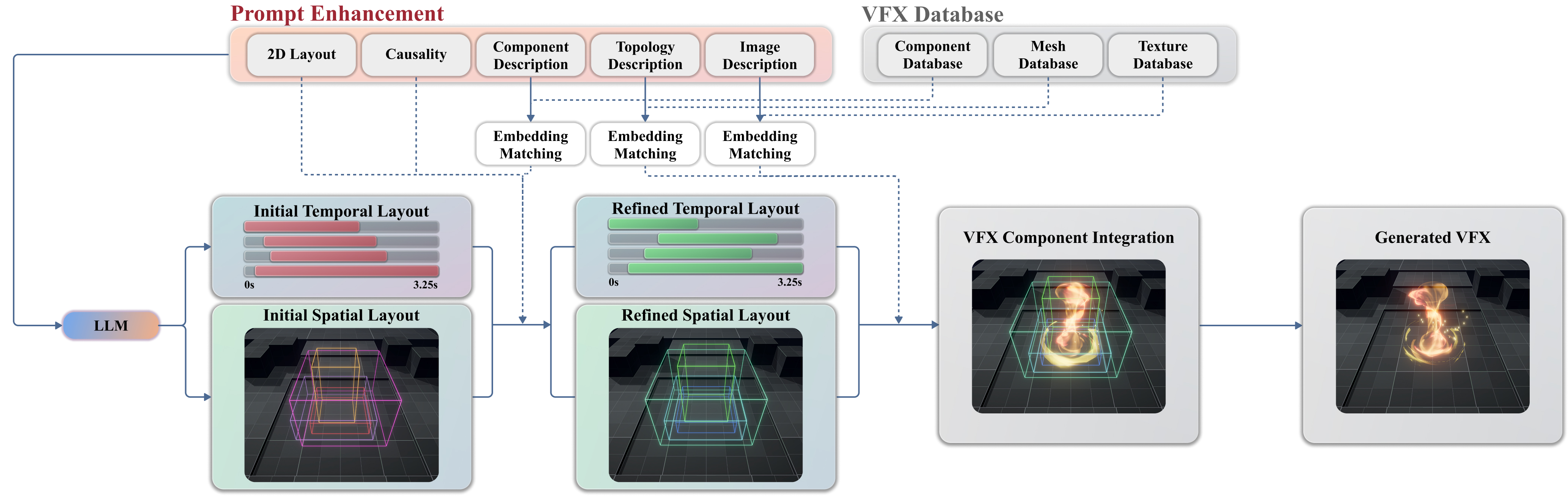
Prompt enhancement
Expand a high-level request into component descriptions and spatial-temporal guidance.
Spatial and temporal design
Retrieve suitable components, arrange their positions and sizes, and refine their activation sequence.
Editable Unity output
Assemble a parameterized VFX draft that supports further adjustment by the designer.
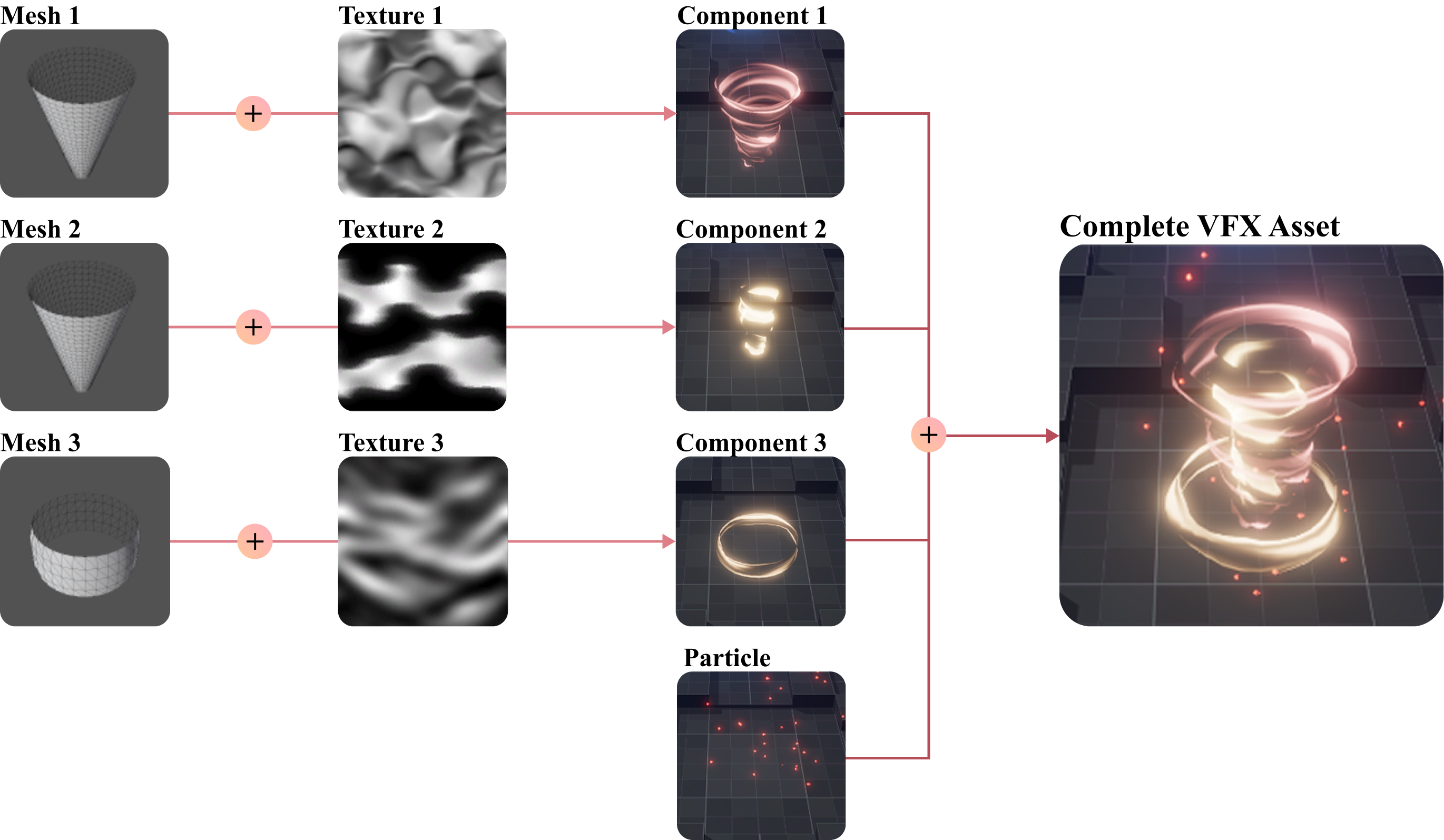
Built from VFX components
- Mesh
- Provides the basic shape and spatial structure.
- Texture
- Tileable noise patterns and shaders create visual detail and flow.
- Particle
- Adds the emission and motion of small finishing details.
Demonstration
See SpeLL in use
The supplementary video shows generation, results, and parameter-based editing.
Download video · A web-sized copy of the original supplementary video.
Code release
Code coming soon.
We are preparing the implementation and documentation for public release. The repository currently contains the project page and a placeholder structure for the Unity client, backend, and data preparation tools.
View repositoryCitation
@inproceedings{oh2026spell,
  author    = {Oh, Jeongseok and Kim, SeungJun},
  title     = {SpeLL: A Generative Framework for Synthesizing 3D Visual Effects
               from Text Prompts with Large Language Models},
  booktitle = {Proceedings of the 39th Annual ACM Symposium on
               User Interface Software and Technology},
  series    = {UIST '26},
  year      = {2026},
  publisher = {Association for Computing Machinery},
  doi       = {10.1145/3830398.3830697},
  url       = {https://doi.org/10.1145/3830398.3830697}
}